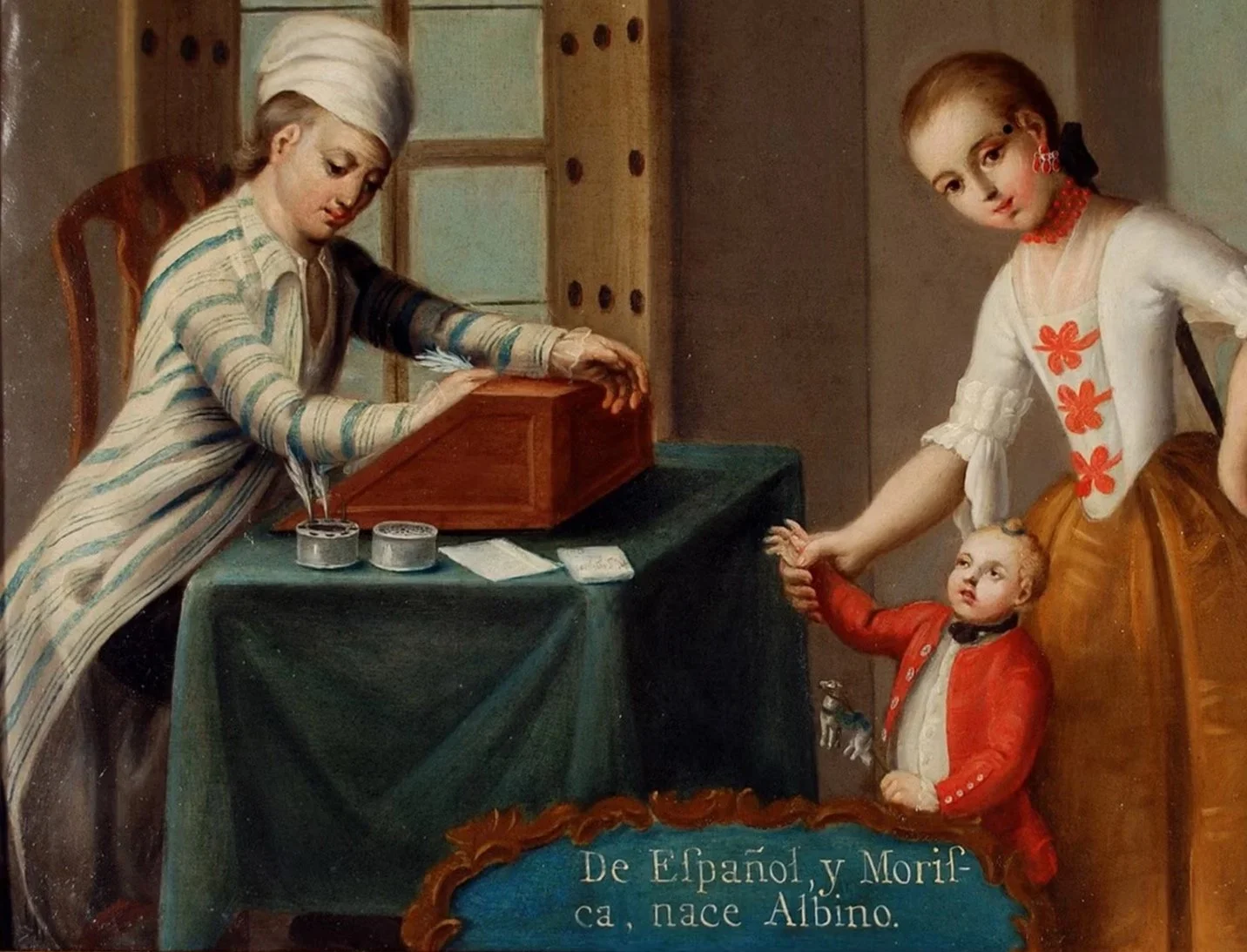
From Spaniard and Morisca (African-descent) woman, is born an Albino. https://ackland.org/new-to-the-ackland-a-spanish-colonial-casta-painting/
The Ruben Carpenter Project
Ruben was born in rural North Carolina just after the end of the Civil War. He lived and worked in Buckhorn (now New Hill), North Carolina.
Ruben’s mother Elizabeth was a married white woman, living in a community that featured large, well-established families of Free People of Color. The exact identity of Ruben’s father was a mystery. However, it was well-known to be someone other than her husband William Carpenter, who was away at war when Ruben was conceived.
Ruben lived with his mother and younger sisters for decades after their father’s death. He worked in the local community, but never married. By the time of his death, it was publicly understood that Ruben was not a white man. This had caused social difficulties for his sisters, who were white women during the era of legal segregation. Ruben, who never married, is represented by a marker in the family cemetery. The story of the marker, the actual grave, and the search for Ruben’s father reflect the times.
Mixed-race families and communities are complex; stories change over the years in ways that are both interesting and challenging.
The goal of this project is to support an ethical telling of Ruben’s story. It is worth considering why four-year old Ruben is enumerated with his parents and sisters, but with race hand-corrected from “white” to “mulatto” by the census taker, or how his biological father may have remained nearby, according to some accounts.
The Ruben Carpenter Project uses a tiered archival model to allow for the maximum freedom of expression. Approved members may share curated archival documents and engage with each other’s works in progress.